Art, Paintings & Handicrafts
Bali's crafts are still village-based: silver in one place, woodcarving in the next, weaving in the east. This is where to buy each one at the source, which galleries and markets are worth the trip, and where you can sit down and learn to make it yourself.
Craft villages — buy at the source
Each village specialises. Prices at the workshop are a fraction of Seminyak boutique prices, and you can usually watch the work being made.
Celuk
Silver & goldGianyar, 20 min from Ubud
The island's silversmithing village. Family workshops line the main road — you can watch granulation and filigree work being done at the bench and buy direct. Most studios also take custom orders and repairs, and many run half-day make-your-own-ring classes.
Mas
WoodcarvingBetween Ubud and Sukawati
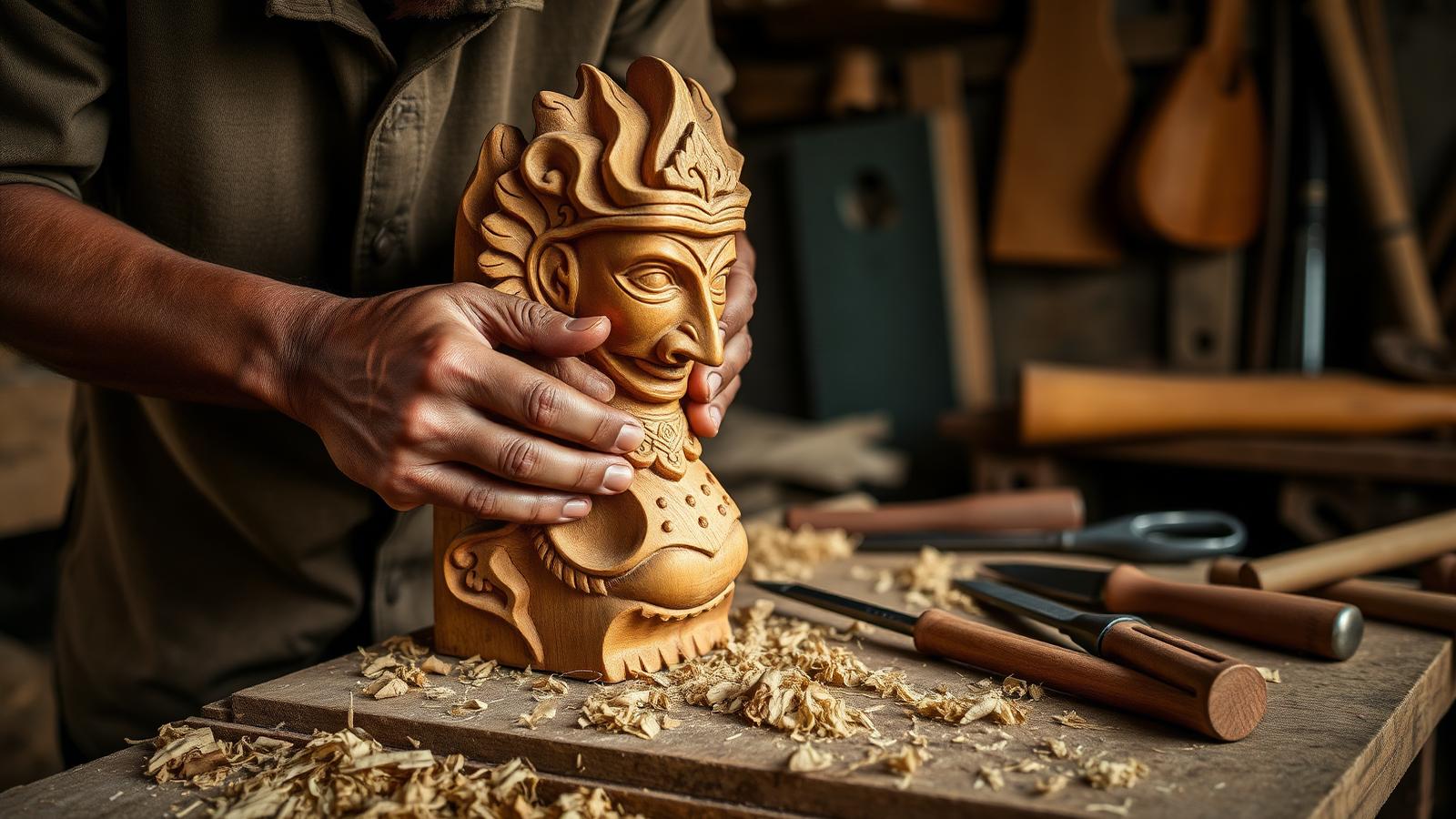
Generations of carvers working hibiscus, crocodile wood, suar and teak — masks, Garuda figures, doors and large sculptural pieces. Bigger galleries here arrange crating and international shipping.
Tegallalang & Pakudui
Timber & handicraftsNorth of Ubud
The 'handicraft road' — kilometres of open-front workshops selling carved panels, wooden bowls, teak furniture, rattan, wind chimes and decorative pieces at wholesale prices. Pakudui specialises in Garuda carvings.
Batubulan
Stone carvingOn the Denpasar–Gianyar road
Paras sandstone and volcanic stone statues, temple gates and garden pieces. Heavy items are shipped by sea; ask for a crated FOB price.
Sukawati & Batuan
PaintingsGianyar
Batuan is home to the dense, dark, ink-detailed Batuan style; Sukawati is where the wholesale art market sits. Painters' home studios around both villages sell directly and are usually happy to show work in progress.
Kamasan
Classical paintingKlungkung, east Bali
The last village painting in the classical wayang style on cloth with natural pigments. Small family studios, and the Kertha Gosa pavilion in Klungkung shows the ceiling paintings the style is known for.
Tenganan
WeavingKarangasem, east Bali
One of only a handful of places on earth making double-ikat gringsing cloth — a single piece can take years, and prices reflect that. Also known for ata basketry and lontar palm-leaf engraving.
Sidemen
Songket & endekKarangasem
Hand-loom weaving villages in the rice terraces. Watch backstrap and pedal looms working, and buy songket (silver/gold thread) and endek by the metre.
Galleries & museums
Look before you buy. An hour in a museum tells you whether a painting is a genuine style piece or a market copy.
Museum Puri Lukisan
Ubud centre
The oldest art museum in Bali. The best single place to learn the schools — Pita Maha, Ubud, Batuan, Young Artists — before you spend money on a painting.
Neka Art Museum
Sanggingan, Ubud
Strong Balinese and expat-in-Bali collection (Lempad, Spies, Bonnet, Blanco, Arie Smit) laid out by style, with a shop.
ARMA (Agung Rai Museum of Art)
Pengosekan, Ubud
Museum plus a working cultural centre — it also runs painting, batik, woodcarving, gamelan and dance classes for visitors.
Setia Darma House of Masks & Puppets
Mas
Thousands of masks and wayang puppets from across Asia in restored joglos. Free entry, and useful context before you buy a mask.
Komaneka Fine Art Gallery
Ubud
Contemporary Indonesian painting and sculpture, museum-standard hanging, fixed prices.
Titik Dua / Uma Seminyak / Nyaman Gallery
Ubud & Seminyak
Contemporary galleries and design shops for modern work, prints and photography — where to look if the traditional styles are not your taste.
Art markets
Cash only, opening prices are 3–4x, and nobody expects you to pay them.
Sukawati Art Market
Sukawati, Gianyar
The wholesale market — paintings, sarongs, baskets, carvings, beads. Two buildings, open early morning to late afternoon. Bring cash and bargain hard.
Ubud Art Market (Pasar Seni)
Opposite Puri Saren, Ubud
Convenient and touristy. Best early morning before the tour buses. Similar stock to Sukawati at higher opening prices.
Guwang Art Market
Next to Sukawati
Quieter alternative to Sukawati with the same goods and slightly calmer bargaining.
Kumbasari Art Market
Denpasar, by the river
Local-facing market over several floors — ceremony goods, textiles, baskets, silver. Very few tourists, very low prices.
Samadi & Love Anchor markets
Canggu
Weekend markets with macrame, ceramics, leather, jewellery and prints from local makers and expat designers.
Textiles — ikat, songket, endek, batik and silk
Bali's cloth is a craft in its own right, still woven on backstrap and treadle looms in village verandahs. These are the places to buy it, and the villages where you can stand and watch it being made.
Tenganan Pegringsingan
Double ikatKarangasem, east Bali
The only village in Indonesia — and one of three places on earth — that makes geringsing double ikat, where both warp and weft are tied and dyed before weaving. A single cloth can take two to five years. Weavers work in the open verandahs along the village lanes and will show you the tying and the natural dye pots. Genuine pieces run into the millions of rupiah; anything cheap is a printed copy.
Sidemen
Songket & endekKarangasem
Green valley village full of small home looms weaving songket — silk or cotton with supplementary gold and silver thread. You can walk in, watch the treadle looms and buy directly from the family that made the cloth. Many houses also run half-day weaving lessons.
Gianyar weaving workshops
EndekGianyar town
Endek is Bali's weft-ikat everyday cloth, now protected and required as office and school wear across the island. Several factory-scale workshops on the Gianyar road run free walk-through tours of the tying, dyeing and weaving floors, with a shop at the end selling by the metre.
Threads of Life
Museum-gradeJalan Kajeng, Ubud
A fair-trade gallery and textile foundation working with weavers across Indonesia. Everything is natural-dyed, documented and priced to pay the maker properly. They run textile appreciation classes and a study collection — the single best hour to spend before buying any serious cloth.
Batik workshops, Ubud & Batubulan
BatikUbud, Batubulan
Hand-drawn batik tulis is applied with a canting wax pen, one line at a time; batik cap is stamped with copper blocks; printed 'batik' is neither. Workshops in Ubud and along the Batubulan road demonstrate all three and run day classes where you wax, dye and take home your own panel.
Klungkung / Semarapura textile market
Best pricesKlungkung
The island's serious cloth market. Endek, songket, batik and ceremonial fabrics sold by the metre and by the piece, mostly to Balinese buyers. Prices are a fraction of Seminyak boutiques and the range is far wider. Go in the morning, take cash.
Sukawati & Ubud art markets
SarongsGianyar
Where most visitors buy their first sarong. Fine for a printed rayon beach sarong at IDR 50k–100k after bargaining — just do not believe the 'hand-made batik' label at that price.
Bebali Foundation & natural dye gardens
Watch it madeAround Ubud and east Bali
Indigo, morinda root, mahogany bark and turmeric dye gardens attached to weaving cooperatives. Tours show the fermentation vats and the difference between a natural indigo that ages beautifully and a synthetic one that runs in the first wash.
Silk and ceremonial cloth in Denpasar
By the metreJalan Sulawesi, Denpasar
Three blocks of fabric shops — silks, brocades, songket, lace and ceremonial cloth — where Balinese families buy for weddings and temple days. Chaotic, cheap, air-conditioned inside, and the tailors nearby will make something up in a couple of days.
Telling the real thing from the printed copy
Buying textiles- Hand-woven or machine? Turn the cloth over. Hand-woven has slight irregularities, visible thread ends and a back that tells the same story as the front. Printed cloth has a pale, blurry reverse.
- Natural or synthetic dye? Natural dyes are slightly uneven, deepen in shade over the cloth and smell faintly of plant matter. Rub a damp white tissue on a hidden corner — heavy colour transfer means poorly fixed synthetic dye.
- Silk or rayon? Silk warms in your hand, rustles, and a single thread burns to a brittle ash that smells of hair. Rayon stays cool, drapes limply and melts into a bead.
- Songket gold thread is usually metallic-wrapped polyester today; real gold-wrapped thread exists and costs accordingly. Ask, and expect a straight answer from a good shop.
- Prices as a rough guide: printed sarong IDR 50k–150k; good endek by the metre IDR 150k–400k; hand-woven songket IDR 1.5m–15m; geringsing double ikat IDR 10m upward.
- Care: hand wash natural-dyed cloth cold with a mild soap, never wring, dry in shade. Store folded with tissue, not on a wooden shelf, and refold along different lines each year.
- Bring textiles home in your luggage where you can. If a large piece is shipped, it still needs a fumigated crate — see Buying large items.
Learn to weave, tie or wax it yourself
Classes- Batik day class, Ubud or Batubulan: IDR 350k–650k including wax, dye and a panel to take home. Half a day is enough for a small piece.
- Backstrap or treadle weaving in Sidemen: IDR 300k–700k for a half-day with a village weaver; you will finish a narrow band, not a cloth.
- Natural dye workshops around Ubud: IDR 400k–900k, indigo vat and morinda root, and you dye a scarf.
- Threads of Life textile appreciation sessions: booked ahead, focused on reading a cloth rather than making one — the best value if you plan to spend real money.
- Tenganan visits: enter respectfully, ask before photographing weavers, and buy something small even if the geringsing is out of reach.
Classes & workshops — make your own
Prices are typical 2026 ranges for a tourist-facing class including materials; village studios booked directly are often cheaper. Book a day ahead and confirm the language of instruction.
Silver & gold jewellery
Half dayStudio Perak (Ubud) and Chez Monique (Celuk) are the long-running names, and dozens of Celuk workshops teach the same thing. You sketch a design, saw, solder, file and polish, and keep the piece — usually a ring or pendant. Expect around 3–4 hours and roughly IDR 400,000–800,000 including a set weight of silver; extra silver or gold is charged by the gram.
Painting
Half dayARMA and Nirvana Batik & Painting in Ubud both run classes with a Balinese teacher, plus many home studios in Batuan and Penestanan. You work in the traditional style — pencil under-drawing, ink outline, layered acrylic or natural pigment washes. Typically IDR 350,000–700,000 with materials and canvas to take home.
Batik
Full dayWax-resist work with a tjanting tool and indigo or synthetic dyes. Widya's Batik and Nirvana in Ubud, plus most cultural centres. Full-day classes finish with a dyed and boiled-off panel or sarong; IDR 400,000–900,000.
Woodcarving
Half dayCarvers in Mas and around Ubud teach chisel work on a small relief panel or mask blank. Slow, quiet, surprisingly hard on the hands. IDR 350,000–700,000.
Macrame & weaving
2–3 hoursCanggu, Ubud and Uluwatu studios run knotting classes for wall hangings, plant hangers and bags, usually in small groups with cotton rope supplied. IDR 250,000–600,000. Rattan and ata basket weaving classes run in Sidemen and Tenganan.
Leather craft
Half dayBali's leather trade is centred on Seminyak (Jalan Raya Seminyak and Kayu Aya) and Kuta, where workshops make bags, belts, sandals and jackets to measure in a few days. Several Canggu and Ubud studios now teach cutting, stitching and tooling — you leave with a card holder, belt or small bag. IDR 400,000–900,000.
Ceramics
2–3 hoursGaya Ceramic (Sayan) runs serious multi-day courses; Kevala and small Canggu studios do drop-in wheel-throwing sessions. Fired pieces need collecting or shipping 2–3 weeks later — plan around your flight.
Offerings & palm-leaf work
1–2 hoursCanang sari and penjor making, taught in villages and by many Ubud homestays. Cheap, often free with a homestay, and the best short introduction to why craft and daily ritual are the same thing here.
Buying well
Bargaining
- Market opening prices are usually 3–4x the real price. Counter at about a third, settle near half, and stay friendly — walking away politely is the strongest move you have.
- Fixed-price galleries and studio workshops are not bargaining venues. Ask for a discount on multiples instead.
- Cash in rupiah gets better prices than card. Most village workshops have no card machine.
- The first sale of the day (penglaris) is considered lucky — early shoppers get better prices.
Silver, gold and fakes
- Balinese silver is normally 925 sterling and stamped. Ask to see the stamp and weigh the piece — reputable Celuk shops price by gram plus workmanship.
- 'Silver-plated' or 'alpaca' is nickel alloy, not silver. It should cost a fraction of the price.
- Gold is sold by karat and gram against the daily gold price; get the weight and karat written on the receipt.
- Mass-produced 'Balinese' carvings and paintings are often imported or machine-made. A hand-carved piece shows tool marks and slight asymmetry; a hand-painted one shows brush texture, not a printed dot pattern.
Shipping it home
- Large carvings, furniture and stone go by sea freight — galleries in Mas, Tegallalang and Batubulan arrange crating and paperwork routinely. Allow 6–10 weeks.
- Small pieces go by courier or in your luggage. Roll unframed canvases in a tube rather than folding them.
- Ask about your own country's import duty and quarantine rules before shipping timber — untreated wood is restricted into Australia and New Zealand.
Protected and restricted items
Careful- Antiques, temple pieces and anything genuinely old may need an export permit — a shop that shrugs at the question is a shop to leave.
- Ivory, turtle shell, coral, and products from protected species are illegal to buy and to carry home.
- Ceremonial krisses and masks used in ritual are sometimes sold when they should not be. Buy new pieces made for sale instead.
Getting there
Celuk, Batubulan, Mas and Sukawati sit in a line on the road between Denpasar and Ubud, so one driver day covers all four comfortably — see Transport help for driver rates. East Bali villages (Kamasan, Tenganan, Sidemen) are a longer full-day loop from the south. Ask the Bali help assistant to plan a craft-village route around where you are staying.