Weather and when to go
Bali sits 8 degrees south of the equator, so it is warm all year. There are only two seasons and the difference between them is rain, not temperature.
Dry season
April – October
27–32°C days, 23–25°C nights
Sunny mornings, lower humidity, and reliable beach days. July and August are peak season: busiest roads, highest villa prices, book early. June and September are the sweet spot.
Wet season
November – March
26–31°C days, humid throughout
Rain usually arrives as heavy afternoon downpours lasting an hour or two, not all-day drizzle. Everything is greener, cheaper, and quieter. January and February are the wettest.
- Sea temperature
- 28–29°C year-round
- Humidity
- 75–85%, higher in wet season
- UV index
- Extreme (11+) most middays
- Altitude effect
- Ubud and the mountains are 3–6°C cooler and rainier
What to pack
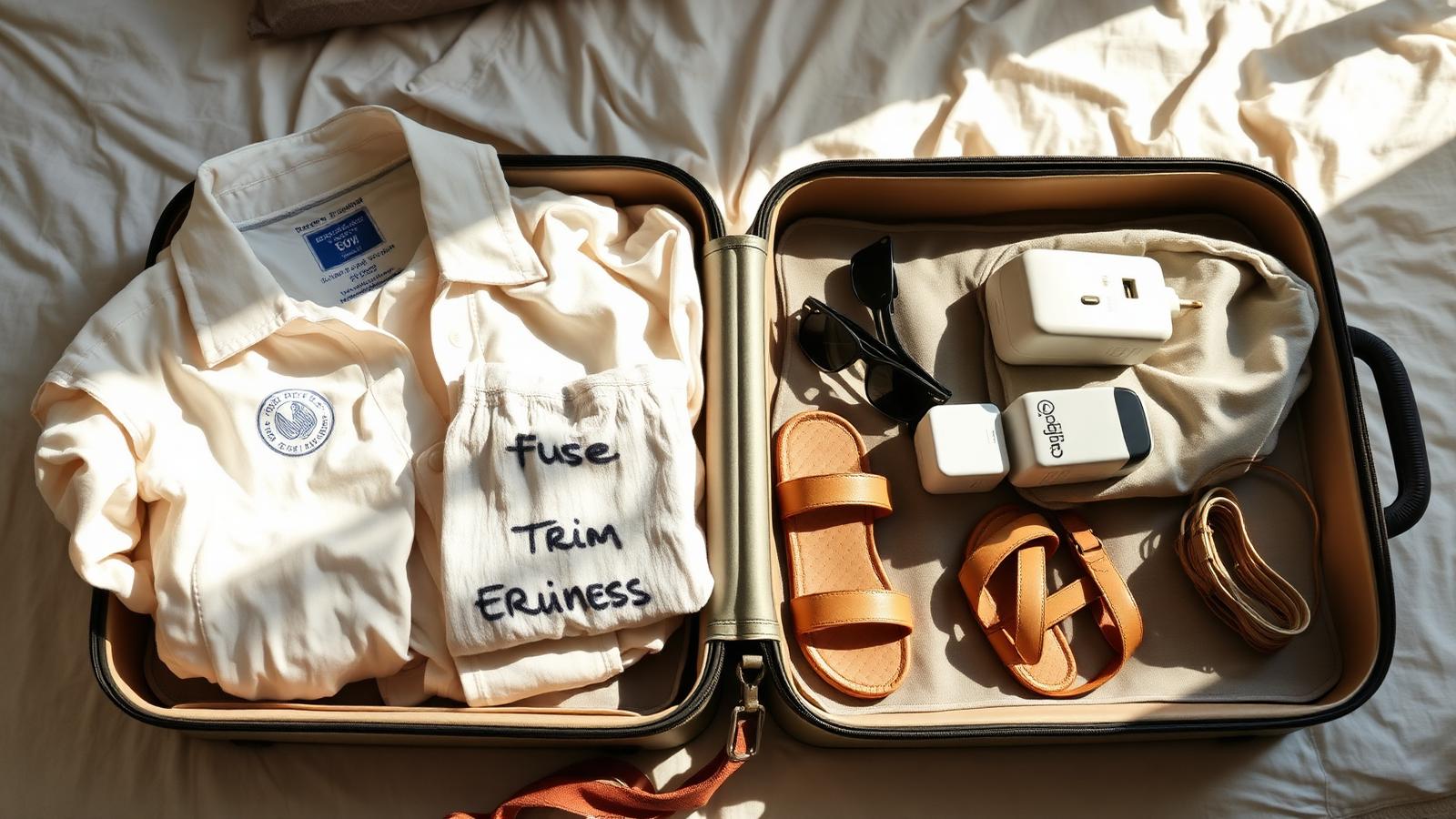
Pack lighter than you think. Laundry costs around IDR 10k per kilo and clothes are cheap here — sunscreen, repellent, and medication are the things worth carrying from home.
Clothing
- Light, loose cotton and linen — you will sweat more than you expect
- One long-sleeve layer for air-con, scooters, and cooler Ubud nights
- A sarong and covered shoulders for temple visits (many temples lend sarongs)
- Two swimsuits — one is always still wet
- Flip-flops plus one pair of trainers for volcano hikes and rice-field walks
- A light rain jacket or a cheap poncho if travelling Nov–Mar
Health & toiletries
- Reef-safe SPF 50 — sunscreen is expensive and often low quality locally
- Strong DEET or picaridin insect repellent (dengue is present year-round)
- Rehydration sachets and electrolytes
- Any prescription medication in its original box, with a copy of the prescription
- Basic first aid: antiseptic, plasters, blister care — scooter grazes are common
- Motion-sickness tablets for winding mountain roads and boat crossings
Tech & practical
- Type C/F plug adapter (see sockets below) and a multi-USB charger
- Power bank — long drives and full days out drain phones fast
- Dry bag for boats, waterfalls, and scooter rides in the rain
- Refillable water bottle — tap water is not drinkable; refill stations are everywhere
- Your own helmet if you plan to ride a lot; rental helmets are usually poor
- Photocopies or photos of passport, visa, insurance, and driving permit
Leave at home
- Heavy clothing and jeans — hot, slow to dry, rarely worn
- Hairdryer — most villas and hotels provide one and they strain the voltage
- Anything valuable you would hate to lose to sand, salt, or a scooter fall
- Vape liquid in bulk quantities and any cannabis product in any form
Bringing medication
This is the one area where getting it wrong is serious. Indonesia treats controlled medication as narcotics regardless of your home prescription. Check your specific drug with the Indonesian embassy before you fly — not a forum, not us.
The general rule
Personal-use medication is fine if it is clearly yours and clearly medicinal. Keep everything in the original labelled packaging, carry it in your hand luggage, and bring a copy of the prescription or a doctor's letter in English stating the condition and the dosage. Quantities should look like a personal supply for the length of your trip.
What gets you in trouble
Indonesia has extremely strict narcotics laws with severe penalties. Codeine, tramadol, strong opioid painkillers, methadone, some ADHD stimulants (including Adderall and methylphenidate), and medical cannabis in any form — including CBD oil — are controlled or banned. Do not assume a legal prescription at home makes it legal here.
If your medication is on that list
Contact the Indonesian embassy or consulate in your country before you fly and ask about an import permit or an alternative. Your prescribing doctor may be able to switch you to a non-controlled equivalent for the trip. Never post medication to yourself in Indonesia — parcels are screened.
Buying medicine in Bali
Apotek (pharmacies) such as Kimia Farma and Guardian are everywhere and cheap. Many drugs that need a prescription at home are sold over the counter. Antibiotics, antihistamines, painkillers, and stomach remedies are easy to find. Stick to established chains to avoid counterfeit stock.
Medication checklist
A practical guide for what you can pack, what to carry on you, and how to avoid problems at Indonesian customs.
Usually fine to bring
- Antibiotics, antihistamines, and basic painkillers (paracetamol/ibuprofen) in personal quantities
- Blood pressure, cholesterol, diabetes, and thyroid medication in original packaging
- Asthma inhalers, EpiPens, and allergy/auto-immune injectors with prescription copy
- Most antidepressants, anti-anxiety meds, and sleep aids — unless they contain controlled substances
- Contraception, hormone replacement, and common dermatology creams
Get explicit advice first
- Codeine, tramadol, or any opioid painkiller — often controlled or banned
- ADHD stimulants such as Adderall, Ritalin, methylphenidate, and dexamphetamine
- Medical cannabis, CBD oil, THC products, or any cannabis-derived item — banned outright
- Sedatives, strong sleeping tablets, and benzodiazepines — check with the Indonesian embassy
- Anything in a syringe or vial that could be mistaken for narcotics — bring a doctor's letter
Documents to carry
- Original prescriptions or pharmacy dispensing labels with your name and drug name
- A doctor's letter in English explaining your condition, dosage, and that the medication is for personal use
- A copy of your travel insurance and medical evacuation cover
- A printed list of all medications and generic names, in case a brand name is unfamiliar locally
Label and pack
- Keep original packaging
- Do not decant pills into unmarked bags. Border officials need to see the pharmacy label with your name, drug name, and quantity.
- Pack in hand luggage
- Carry medication you need en route and within the first 24 hours in your carry-on. Lost luggage is common; temperature-sensitive meds belong with you, not in the hold.
- Be careful with pill organizers
- A weekly organizer is fine for resort use, but keep the original boxes and labels too. Do not rely on an organizer as proof at customs.
- Quantity should look personal
- Bring enough for your trip plus a small buffer for delays. A 90-day supply of a controlled drug raises questions; a 2–3 week supply of a routine medication does not.
- Liquids, creams, and refrigerated items
- Insulin, growth hormone, and biologics need cold packs. Declare them at security if asked. Eye drops and liquid antibiotics count as liquids at airport screening.
For clinics, hospitals, and insurance, see the medical guide.
Plugs, sockets, and power
- Plug types
- Type C and Type F — the round two-pin European plug
- Voltage
- 230V
- Frequency
- 50Hz
- UK / US / AU visitors
- You need an adapter; buy one before you fly or at any minimarket
What this means for you
- Phones and laptops: modern chargers are 100–240V, so you only need the plug adapter, not a voltage converter.
- US/Japan appliances: anything 110V only — some hair tools, shavers, older devices — needs a step-down transformer or it will burn out.
- Sockets are often loose and rarely earthed in older buildings. A multi-plug travel adapter with USB ports saves fighting over one socket.
- Power cuts happen, particularly in the wet season and in Ubud and the north. Keep a power bank charged and a torch on your phone.
Does everyone speak English?
In the tourist south — Kuta, Seminyak, Canggu, Uluwatu, Sanur, Ubud — yes, largely. Hotel staff, drivers, restaurants, and shops deal with international visitors daily and English is good to excellent. You can travel comfortably without a word of Indonesian.
Away from those areas it thins out fast. In the north and west, in villages, at local warungs, with older people, and in government offices such as immigration, English can be limited or absent. Google Translate with the Indonesian pack downloaded offline handles almost everything.
Two languages are in play: Bahasa Indonesia, the national language everyone speaks, and Balinese, spoken at home and in ceremony. Learn a few words of Indonesian — it is a genuinely easy language with no tenses or genders, and the reaction you get for trying is worth the effort.
Worth learning
- Selamat pagi / siang / sore / malam
- Good morning / midday / afternoon / evening
- Terima kasih
- Thank you
- Tolong
- Please / help me
- Berapa harganya?
- How much is it?
- Terlalu mahal
- Too expensive
- Tidak, terima kasih
- No, thank you
- Enak!
- Delicious!
- Permisi
- Excuse me
Changing money
The currency is the Indonesian rupiah (IDR). Money-changer sleight of hand is one of the most common scams in Bali, and it is entirely avoidable.
Use authorised money changers only
Look for PT Central Kuta, BMC, or a changer with a visible "Authorized Money Changer" licence and a proper shopfront. Avoid tiny booths advertising a rate far above everyone else's — that gap is the scam. Count your money yourself, in front of them, before handing over your notes, and never let the cashier recount it after you.
ATMs
Withdraw from ATMs attached to a bank branch or inside a supermarket, never a standalone machine on a quiet street. Most machines cap withdrawals at IDR 2.5–3 million and charge IDR 25k–50k. Choose "decline conversion" when asked — your own bank's rate is almost always better.
Cards vs cash
Hotels, larger restaurants, and supermarkets take cards. Warungs, markets, small drivers, temple donations, and parking are cash only. Carry IDR 200k–500k in small notes — nobody can break a 100k note for a 5k parking fee.
Know the zeros
Rupiah has a lot of zeros: 50,000 and 500,000 look alike when you are tired. Notes are colour-coded — the 100k is red, the 50k blue, the 10k purple. Count in "thousands": 50k is roughly USD 3, 500k roughly USD 30.
Live exchange rates
Updating…
Mid-market rates from open.er-api.com. Changers and ATMs will give you a little less — treat these as a sanity check, not a quote.
Quick converter
Estimate what you should get before you hand over cash.
You should get roughly
Loading rates…
Mid-market maths only. A good changer lands within a few percent of this — if a quote is far below, walk away.
Common denominations
Approximate guide rates
Rates move daily. Treat these as a quick mental shortcut, not a quote. Use an app like XE or Wise on the day for accuracy.
| Rupiah | Rough value | What it buys |
|---|---|---|
| IDR 10,000 | USD 0.65 | Small street snacks, parking, a small bottle of water |
| IDR 20,000 | USD 1.30 | Local coffee, a beer in a cheap warung, short bike-taxi hop |
| IDR 50,000 | USD 3.25 | Lunch at a local warung, a Grab car across town, a t-shirt |
| IDR 100,000 | USD 6.50 | Dinner at a mid-range restaurant, two hours of massage, a day scooter rental |
| IDR 500,000 | USD 32.50 | A couple of days of groceries, a private-driver half-day, a nice villa dinner |
Where to change money
ATMs are usually the simplest option. If you have leftover cash to swap, use one of the authorised chains below.
- PT Central Kuta Authorised changer
- Long-established, fixed rates, printed receipts, counting machines. Branches across Kuta, Legian, Seminyak, Ubud and Sanur.
- BMC / Dirgahayu Authorised changer
- Reliable chains with proper shopfronts. Better for large USD/EUR notes; count your cash yourself before leaving.
- Bank ATMs (BCA, Mandiri, BNI) ATM withdrawal
- Withdraw inside a bank branch or mall. Decline the machine's conversion (DCC). Most cap at IDR 2.5–3m per transaction.
- Ngurah Rai airport booths Convenience only
- Rates are poor and queues are slow. Only change enough for the taxi/SIM and a meal, then use an ATM or authorised changer in town.
- Street-side 'no commission' booths Avoid
- The classic short-count scam. If the rate is noticeably better than everywhere else, the difference is coming out of your pocket.
Map of recommended changers and bank ATMs
Licensed chains and bank ATMs by area. Filter by type or area, tap a pin for hours and a local note, then open directions in one tap.
Kuta & Legian
The highest concentration of dodgy booths in Bali. Stick to the licensed chains on Jl. Raya Kuta and Jl. Legian, or use mall ATMs at Beachwalk.
Seminyak & Kerobokan
Rates are fine but hotel and villa desks are not. Use the Jl. Raya Seminyak chains or the ATMs inside Seminyak Village.
Canggu & Berawa
Lots of small booths aimed at long-stayers. Only use a shop with a visible licence and a counting machine; street ATMs here are best used in daylight.
Ubud
Good rates around Jl. Raya Ubud. Machines near the market can run empty on weekends — the BCA branch is the reliable one.
Sanur
Quiet and low-hassle. Jl. Danau Tamblingan has both a licensed chain and plenty of bank ATMs.
Jimbaran & Nusa Dua
Resort-heavy, so few independent changers. Bring cash for the Jimbaran seafood strip — many warungs there are cash-only.
Uluwatu & Bukit
Thin coverage and ATMs that empty out. Draw cash before you drive up, especially for beach clubs and cliff warungs.
Denpasar
Bank branches with the best limits and teller service. Worth the trip if you need a large sum or have older-series notes.
Airport
Convenience only. Change a small amount on arrival and do the rest in town.
Pins are area/street accurate rather than exact doorways, and branches do move. Always check for a visible "Authorized Money Changer" licence and count your cash before leaving the counter.
Bring clean notes
If you are changing cash, bring newer, unmarked, uncreased notes — large denominations get the best rate and torn or older-series notes are often refused or discounted. Honestly though, an ATM withdrawal on arrival is simpler and usually just as good.
Bag packed. Now the arrival.
Next up: what actually happens between stepping off the plane and reaching your hotel, and which visa you need before you board.