Buying large items
A carved door, a teak table, a stone statue, a whole villa's worth of furniture — Bali makes it very easy to buy big and very easy to get the shipping wrong. This is what to agree before you pay, how to make sure nothing lives inside your timber, and what it will actually cost, both here and when it lands at home.
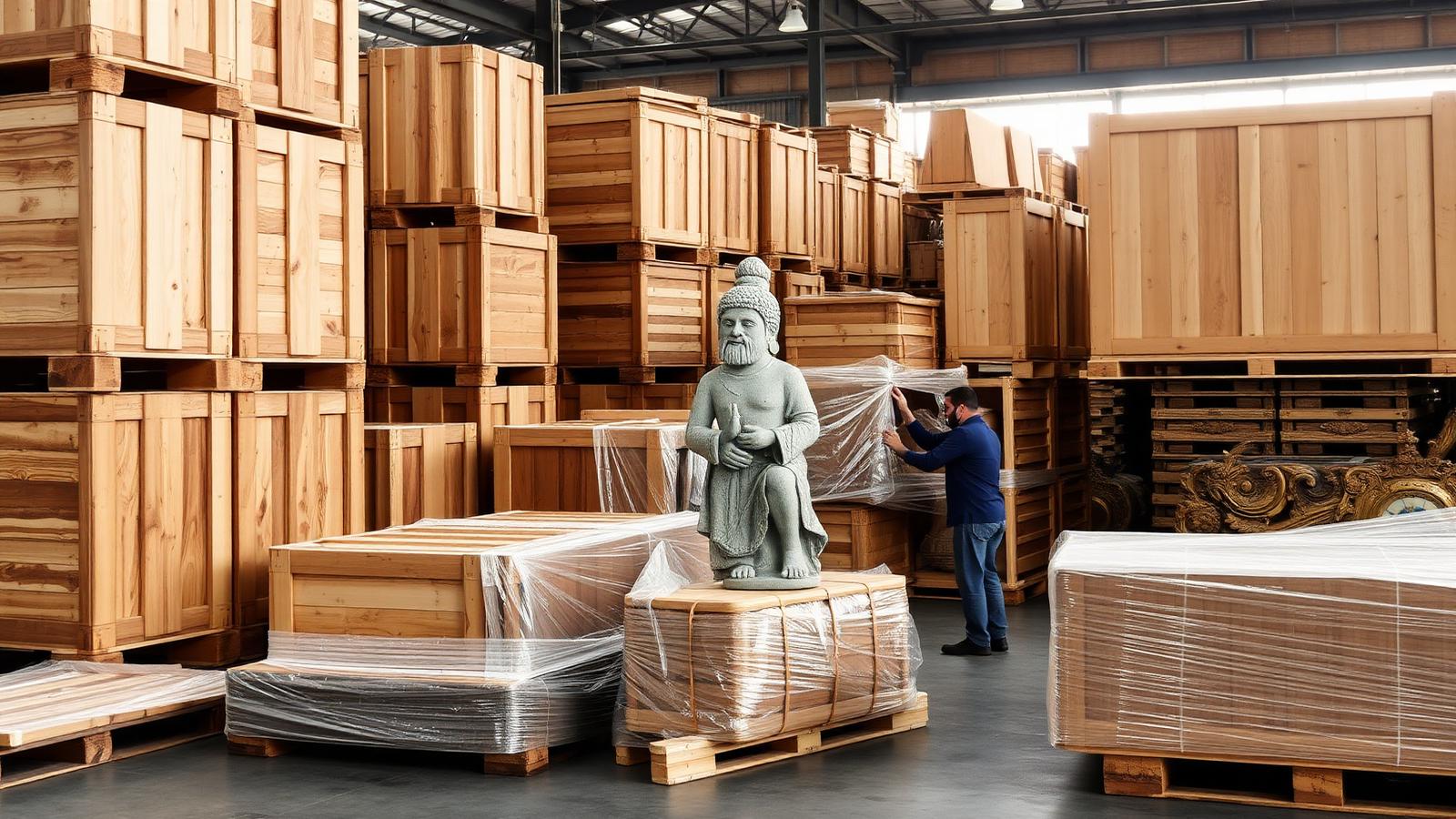
Before you pay the deposit
Five things that decide how the next three months go.
Decide before you pay a deposit
The moment you hand over money the shop's interest in the logistics drops. Agree the shipping arrangement, who crates it, who fumigates it and who pays which fees in writing, in English, before the deposit.
Get the price in the right terms
EXW (ex-works) means the price is the item sitting in the shop — everything else is yours. FOB Benoa/Surabaya means the seller gets it packed, cleared and loaded onto the vessel. CIF means they also pay sea freight and insurance to your port. Ask for both an EXW and an FOB number so you can see what the seller is actually charging for handling.
Measure and weigh it
Freight is charged on whichever is greater — actual weight or volumetric space. Get the crated dimensions in centimetres and the crated weight, not the bare item's. A 2 m carved door becomes a 2.3 m crate.
Photograph everything
Photos of the item before crating, during crating and of the sealed crate. If it arrives split, chipped or swapped for a lesser piece, photos are the only leverage you have.
Get a proper receipt and invoice
Full description, materials, quantity, price paid, seller's name, address and tax number. Customs at both ends work off this document. 'Wooden item — USD 100' written on a scrap of paper will cause you problems.
Vermin, fumigation and quarantine
The single most common reason a Bali shipment turns into a bill. Tropical timber is alive until it is treated.
Why timber is the problem
Untreated wood can carry borers, termites, powderpost beetle larvae and fungal spores. Australia, New Zealand, the US, Canada and the EU all regulate it, and Australia and NZ are the strictest in the world. If your crate fails inspection at the destination, you pay for treatment, storage and re-inspection — often more than the item cost.
ISPM 15 — the crate itself
The wooden crate or pallet must be heat-treated or fumigated and stamped with the ISPM 15 mark (a wheat-ear logo, country code, treatment code HT or MB, and the facility number). No stamp means the crate can be rejected on arrival even if the contents are fine. Photograph the stamp.
Fumigation of the goods
For raw or lightly finished timber, rattan, bamboo, dried grasses and unfired terracotta, ask for methyl bromide fumigation or kiln/heat treatment of the goods and a Fumigation Certificate naming the item, the dose, the duration and the treatment date. Cost is usually USD 40–120 per consignment. Have it done in Bali — it is a fraction of the destination price.
Phytosanitary certificate
Issued by Indonesian quarantine (Karantina Pertanian) for plant-based goods. Some destinations require it in addition to fumigation. Your freight forwarder arranges it; expect USD 30–80.
Clean it before it is crated
Soil, bark, seeds, leaf litter, insect frass and even a spider nest in a carved recess will fail a quarantine inspection. Inspect the item yourself in daylight: tap it, look for pin-holes and fine sawdust, check the underside and any hollow sections.
Stone, ceramic and metal
Far easier — no fumigation needed for the goods, but the crate still needs the ISPM 15 stamp and the stone must be free of soil. Sandstone and volcanic stone are heavy: get a weight before you commit, because sea freight on a garden Buddha can exceed its purchase price.
How to ship it
Match the method to the size, value and how soon you need it.
Air freight
5–10 daysFor anything urgent, small and valuable — a painting, a small carving, textiles. Charged on volumetric weight, roughly USD 8–15 per kg from Denpasar with a minimum charge. Fast, simple, expensive per kilo, and you still clear customs at the other end.
Sea freight — LCL (shared container)
5–10 weeksThe normal way to send one or two pieces of furniture. You pay for the cubic metres you use — usually USD 200–450 per CBM from Benoa or Surabaya to Australia, more to Europe or North America — plus origin handling, documentation and destination charges. Minimum billing is often 1 CBM even if your crate is smaller.
Sea freight — FCL (full container)
5–9 weeksWorth it once you have roughly 12+ CBM (a 20 ft container) or 25+ CBM (40 ft). Common for people furnishing a whole house. Total cost varies wildly by destination but per-cubic-metre it is far cheaper than LCL.
Door-to-door via the seller
EasiestEstablished galleries in Mas, Tegallalang and Batubulan do this every week and it is genuinely convenient. Get the quote broken down and ask explicitly whether destination charges, duty and quarantine are included — usually they are not.
Independent freight forwarder
Best controlUse a Bali-based international forwarder rather than the shop's cousin. They quote line-by-line, handle export permits, fumigation and the bill of lading, and they exist tomorrow if something goes wrong.
In your luggage
CheapestExcess baggage on a full-service airline is often cheaper than air freight for 20–30 kg. Paintings travel rolled in a tube; check your airline's oversize rules and dimension limits before you buy the frame.
What it costs in Bali
Typical 2026 ranges. Ask for each of these as a separate line on the quote — a single lump sum hides the padding.
- Crating and packing: IDR 500k–3m depending on size, and more for a custom timber crate with foam and corner protection.
- Fumigation and phytosanitary certificate: USD 60–200 combined.
- Inland trucking to Benoa or Surabaya port: IDR 500k–2.5m.
- Export clearance, documentation and bill of lading: USD 80–200.
- Origin terminal handling (THC): USD 60–150 per shipment.
- Marine insurance: typically 1–2% of declared value. Take it — LCL crates get dropped.
- Export permit for anything genuinely antique or culturally significant: allow weeks, not days, and expect the seller to shrug. If they will not help with the paperwork, do not buy it.
What it costs at home
This is the part that surprises people. Freight is often the smaller half of the bill.
The charges nobody quotes you
Almost every 'shipping included' quote stops at the destination port. What lands on you after that: destination terminal handling, LCL de-consolidation, customs brokerage, duty, sales tax, quarantine inspection, any treatment ordered, port storage while all of that happens, and final delivery to your door. On a single LCL crate this commonly adds USD 400–900 — sometimes more than the freight itself.
Australia
StrictestGST of 10% on the goods plus freight and insurance; duty is often 0–5% on handicrafts and furniture. Biosecurity is the real cost: an inspection fee, and if timber is untreated, mandatory fumigation at the wharf plus storage while it happens. Budget AUD 600–1,200 in destination charges on a normal LCL crate. Get treatment certificates from Bali or you will pay several times over.
New Zealand
StrictestSimilar to Australia: 15% GST, MPI biosecurity inspection, and zero tolerance on soil, bark and live pests. Untreated wood and unfumigated rattan are routinely held. Destination charges commonly NZD 700–1,400.
United States
ModerateDuty is often low or zero on original artworks and many handicrafts, but customs brokerage, ISF filing (USD 30–100, and a penalty if filed late), port fees and delivery add up. Lacey Act declarations apply to wood products — your forwarder needs the species name. Budget USD 500–1,000 in destination charges.
United Kingdom & EU
ModerateVAT (20% UK, 17–27% EU) is charged on the value of the goods plus freight plus duty, and duty on furniture and handicrafts is typically 0–5.6%. EUDR/timber-legality paperwork may be requested for wooden goods. Clearance and delivery charges GBP 250–500 on top.
Canada, Singapore, UAE and elsewhere
Check firstRules vary widely — Singapore has minimal duty but strict declarations; Canada applies GST/HST plus CFIA inspection on wood. Before you buy, search your own customs authority's site for the item type and get the tariff code from the seller.
Declared value, duty codes and paperwork
- Never let a seller under-declare the value to 'help with customs'. If the crate is lost or crushed, your insurance pays out the declared value — not what you actually paid.
- Under-declaring is also fraud in your own country, and an obviously wrong figure invites a full inspection.
- Get the HS tariff code for the item. Original artworks, antiques over 100 years old and handicrafts often attract lower duty than 'furniture' — but only if they are classified correctly on the paperwork.
- Keep the seller's invoice, the packing list, the bill of lading, the fumigation certificate and the insurance policy in one folder. Your customs broker will ask for all five.
The timeline, start to finish
Sea freight from Bali is normally 6 to 10 weeks door to door.
- Buy the item and agree crating, fumigation and Incoterms in writing.
- Seller or forwarder crates it; you get photos and the crated dimensions and weight.
- Fumigation and phytosanitary certificates issued; ISPM 15 stamp on the crate.
- Trucked to Benoa or Surabaya, export cleared, loaded. You receive the bill of lading.
- Sea transit — 2 to 6 weeks depending on destination and transhipment.
- Arrival notice from the destination agent, followed by an invoice for destination charges. Pay it or the crate accrues storage daily.
- Customs entry lodged by your broker; duty and tax paid; quarantine inspection if required.
- Delivery to your door — confirm whether it is kerbside only. Two people and a doorway measurement are your problem, not theirs.
Red flags
Any one of these is a reason to slow down and ask more questions.
- A verbal quote only, or a single all-in figure with no breakdown.
- 'Don't worry, no tax at your end' — there is always tax at your end.
- No fumigation certificate offered for raw timber, rattan or bamboo.
- No ISPM 15 stamp on the crate photo.
- Refusal to provide a written invoice with the business's tax number.
- Pressure for full cash payment up front. Deposit 30–50%, balance on proof of loading, is normal.
- A shop that says an antique needs no export permit. If it is genuinely old, it does.
Where this comes up most
Furniture and carvings in Mas and Tegallalang, stone in Batubulan, and textiles and antiques around Ubud — see Art & handicrafts for the villages themselves. For contracts, company purchases or anything involving property, the legal contacts on the Work, invest & retire page are the right first call.